
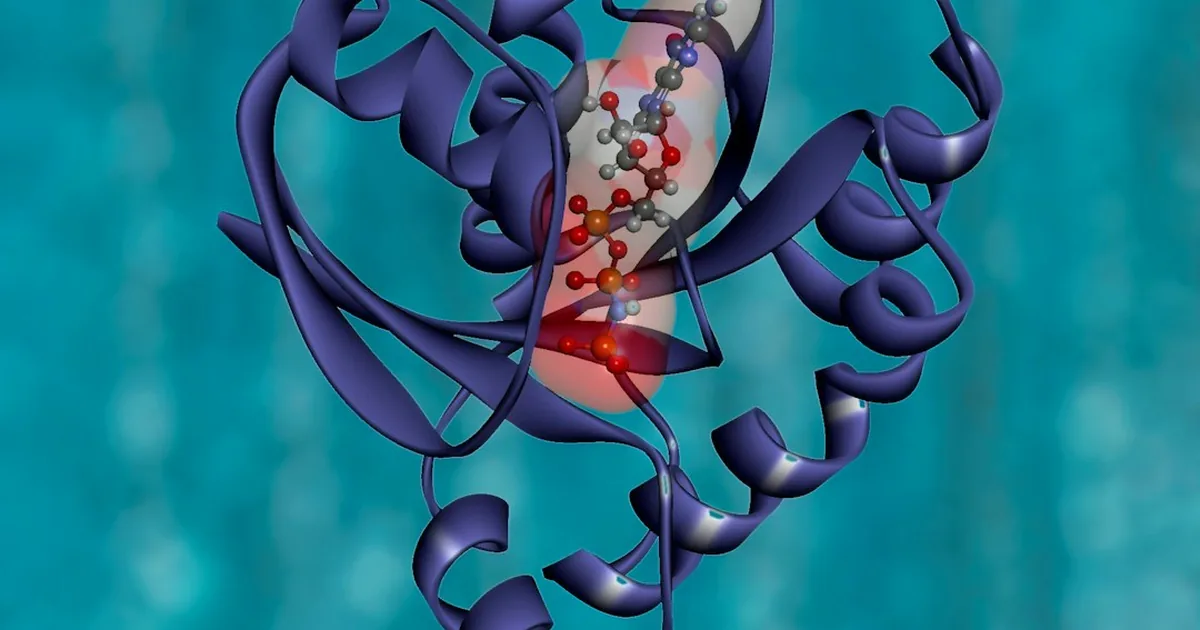
Ac-SDKP is a four-residue peptide with a two-enzyme origin and a one-enzyme exit. Anyone reading about thymosin beta-4 fragments soon asks where it comes from and what removes it. Those two answers decide where the peptide turns up and how long it lasts. This article walks through the Ac-SDKP biosynthesis prolyl oligopeptidase ACE story as it appears in preclinical papers. Everything here is for research use only and describes laboratory findings in rat tissue, purified enzymes and crystal structures, not outcomes in people.
Where Ac-SDKP comes from: the thymosin beta-4 N-terminus
Short answer: Ac-SDKP is the first four amino acids of thymosin beta-4, cut loose by enzymes.
Thymosin beta-4 is a 43-residue peptide. Its N-terminal end carries the sequence acetyl-serine, aspartate, lysine, proline, written Ac-SDKP. One bond, between proline at position 4 and aspartate at position 5, separates the tetrapeptide from the rest of the chain, according to work on prolyl oligopeptidase and Ac-SDKP release. A research profile of the parent peptide describes the same arrangement: meprin-alpha makes the first cut, prolyl oligopeptidase makes the second, and ACE clears the product.
Keep the fragments straight, though. Ac-SDKP and TB-500 are not the same thing, a point we cover in our comparison of two different thymosin beta-4 fragments. If you want the structural background on the parent molecule, see how beta-thymosins bind actin.
Why do the enzymes matter more than the sequence? A peptide this short can be made or destroyed by only a few proteases. Name them, and you know where the peptide can appear and what can switch it off.
Step one: meprin-alpha trims thymosin beta-4
Short answer: meprin-alpha cuts thymosin beta-4 into N-terminal fragments shorter than 30 residues.
A review of the Tβ4-POP-Ac-SDKP axis describes meprin-alpha as the enzyme that produces NH2-terminal intermediates such as residues 1-13, 1-19, 1-21 and 1-24. Each is shorter than 30 residues, and that length turns out to be the point. Prolyl oligopeptidase, the next enzyme in the chain, works on peptides up to roughly 30 residues. It cannot act on the full 43-residue parent.
That is why the rat-tissue authors proposed that another peptidase must truncate thymosin beta-4 first, a step they did not test themselves. Later kidney work supplied a candidate in meprin-alpha.
Why the intermediates matter
The intermediates are the hand-off between the two enzymes. Without them, purified POP and intact thymosin beta-4 would not be expected to yield the tetrapeptide, and the authors of the 2015 study noted exactly that pure POP did not generate Ac-SDKP in an earlier report. Tissue homogenates, which contain other peptidases, did.
Step two: prolyl oligopeptidase releases the tetrapeptide
Short answer: prolyl oligopeptidase (POP), a serine protease that cuts after proline, frees Ac-SDKP from the intermediates.
POP is widely distributed in mammalian organs. The same review notes that POP activity is higher in normal liver than in chronically injured liver, and that it declined over time in rats given carbon tetrachloride, with a matching fall in endogenous Ac-SDKP release.