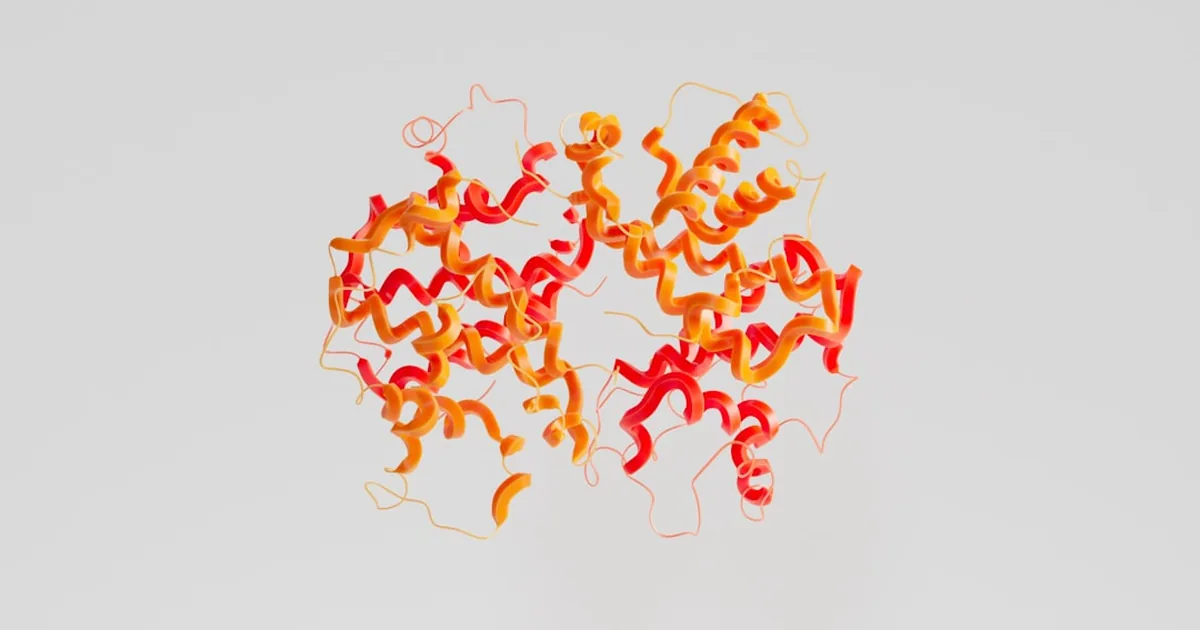
AOD-9604: The Growth-Hormone Fragment Researchers Are Studying
AOD-9604 is a synthetic 16-amino-acid analogue of the C-terminal tail of human growth hormone. It is interesting to researchers because its published in-vitro profile diverges from full-length hGH in informative ways — without engaging the canonical growth-hormone receptor — and yet it has never been approved as a therapeutic anywhere in the world.
by Research Assistant·
Trim the last sixteen amino acids off human growth hormone, add a tyrosine to the front, and the resulting peptide looks chemically related to growth hormone — but in published assays it behaves almost nothing like it. That oddity is why AOD-9604 has held the attention of peptide chemists for more than two decades. This article walks through what AOD-9604 is at the molecular level, what the published in-vitro and animal work actually shows, and where the compound sits today in the regulatory and sport-testing landscape. Everything that follows is framed as research chemistry. AOD-9604 is sold strictly for research use only; it is not a medicine, and it is not approved for human or animal consumption anywhere in the world.
What AOD-9604 Is at a Molecular Level
AOD-9604 is a synthetic 16-amino-acid peptide corresponding to residues 176 to 191 of human growth hormone, with one structural twist: an extra tyrosine residue tacked onto the N-terminal end. That single substitution is the difference between the bare academic fragment and the molecule peptide chemists actually work with under the AOD-9604 name.
A 16-amino-acid fragment with a single tyrosine modification
The parent molecule, human growth hormone, is a 191-residue polypeptide. The stretch from position 176 through 191 is the C-terminal tail — the region researchers pulled out when they wanted to ask whether a small slice of hGH could reproduce a subset of the parent's biology on its own. AOD-9604 is the version of that fragment most published work points to: H-Tyr-Leu-Arg-Ile-Val-Gln-Cys-Arg-Ser-Val-Glu-Gly-Ser-Cys-Gly-Phe-OH. Its two cysteine residues form an intramolecular disulfide loop, mirroring a feature of the parent hGH structure.
Molecular formula and weight
The PubChem record for AOD-9604 lists the molecular formula as C78H123N23O23S2 and the molecular weight at approximately 1816 daltons. Full-length hGH, by comparison, weighs in around 22 kilodaltons — more than twelve times the mass of the fragment. That size gap is part of why the molecule is chemically interesting: it's a structurally minimal scaffold compared with the parent hormone, and any retained biological activity at that size is informative about which regions of hGH are doing which jobs.
Where it came from
AOD-9604 was developed by an Australian company called Metabolic Pharmaceuticals. The "AOD" in the name stood for "anti-obesity drug" — that was the framing of the original program. The corporate program eventually wound down (we'll get to that), but the compound and its associated literature stayed in circulation as a research-grade peptide that academic groups continued to study for its unusual receptor pharmacology.
Why Researchers Came to AOD-9604 in the First Place
Growth hormone is a busy molecule. Inside a living organism it does several things at once: it promotes longitudinal growth, it raises insulin-like growth factor 1 (IGF-1), it has effects on protein metabolism, and it has separate effects on the way fat cells handle stored triglycerides. From a peptide-chemistry standpoint, that raises an obvious question — are those activities anatomically separable across the parent molecule, or do they all live in the same structural region?
The hypothesis of separable activities
Why does that question matter? Structurally. If the metabolic activity of growth hormone lives in one part of the molecule and the growth-promotion activity lives in another, then a researcher could in principle build a small peptide that captures one without the other. That's the core idea AOD-9604 was designed to interrogate. For background on how researchers approach the broader growth-hormone-axis chemistry, the CJC-1295 chemistry article on this site walks through a related but distinct compound family.
The C-terminal region as a candidate
Earlier rodent work had suggested that the C-terminal region of growth hormone — the tail end of the molecule — was associated with lipolytic markers in adipose tissue assays, while leaving the IGF-1 axis untouched in the same experiments. That pointed researchers toward the 176-191 stretch as a candidate region worth isolating and studying on its own.
The tyrosylation modification
The bare hGH 176-191 fragment is one thing. AOD-9604 is what you get when you add a tyrosine residue at the N-terminus. Metabolic Pharmaceuticals introduced that modification during preclinical work to improve the in-vitro stability characteristics of the fragment. The result is a chemically distinct molecule that the literature handles as separate from the bare 176-191 sequence, even though the two share most of their structure.
How AOD-9604 Differs From Full-Length Growth Hormone
This is the part that makes the compound chemically interesting to peptide researchers. AOD-9604 looks like a piece of growth hormone, but in published assays it does not behave like growth hormone in two specific, well-documented ways.
No binding to the canonical growth-hormone receptor
A review of the in-vitro pharmacology of hGH fragment 176-191 and its derivatives reports that AOD-9604 does not engage the canonical growth-hormone receptor (GHR) in standard radioligand-binding assays. Full-length human growth hormone binds GHR; the structurally minimal C-terminal fragment apparently does not. That divergence is informative on its own. It implies that whatever activity AOD-9604 shows in cell-culture work is downstream of an alternative signaling pathway — one the published literature describes as incompletely characterized at the molecular-mechanism level.
No reported IGF-1 elevation in published animal studies
Full-length hGH famously raises circulating IGF-1 in animal and human work, and that elevation is the proxy biomarker most growth-hormone research has historically tracked. The animal-model literature on the tyrosylated fragment reports a different pattern. In the Heffernan and colleagues 2001 paper in Endocrinology, the comparison between full-length recombinant human growth hormone and a tyrosylated C-terminal fragment specifically noted that the fragment did not produce the IGF-1 elevation measurable with the parent molecule under the same experimental conditions.
Implication for receptor pharmacology research
Together those two findings — no GHR binding, no IGF-1 elevation — are why AOD-9604 has continued to attract academic interest long after its commercial development ended. The compound is a useful tool peptide for asking whether the activities of growth hormone really are structurally separable across the parent molecule. In that respect AOD-9604 sits alongside other receptor-research peptides on this site such as Ipamorelin, which similarly attracts academic attention because of receptor-selectivity questions rather than therapeutic potential.
What the Animal-Model Literature Actually Shows
Worth being careful here. The published support for AOD-9604 sits at the level of in-vitro assays and animal-model work. Two specific studies anchor most of the discussion in the literature.
The Heffernan 2001 ob/ob mouse study
The clearest in-vivo benchmark for the compound is the Heffernan study mentioned above. The researchers worked with genetically obese (ob/ob) mice and gold-thioglucose-injected obese mice — two standard rodent models for studying metabolic biology in the lab. Over a 14- to 19-day exposure window, the tyrosylated C-terminal fragment produced statistically significant decreases in measured body-weight gain and statistically significant increases in fat-oxidation markers, while in parallel measurements not elevating IGF-1 the way full-length hGH did in the same animals.
Keep the framing tight here. The paper describes findings in laboratory mice. It is not a statement about human outcomes, and it is not a statement about what the compound does in any living organism other than the animal models reported in the study. Researchers read the paper as a mechanism-of-action question: the fragment retained part of the parent hormone's metabolic signal in those rodent models, without retaining the IGF-1 signal.
The 2015 rabbit knee-osteoarthritis study
The second commonly cited animal study moved away from metabolic chemistry entirely. A 2015 paper looked at AOD-9604 in a collagenase-induced rabbit knee osteoarthritis model. Animals received milligram-scale weekly intra-articular delivery of either AOD-9604, hyaluronic acid, the combination of the two, or a vehicle control, over a four- to seven-week period. Histopathological scoring of articular cartilage and synovial tissue showed improvements in morphology and decreased degradation markers in the AOD-9604-treated groups versus control, with the combination of AOD-9604 plus hyaluronic acid producing the largest histological improvement and the shortest observed lameness period.
This study widened the academic interest in the compound beyond its original metabolic-research framing. It put AOD-9604 into the same broader category as other tissue-research peptides on this site, such as TB-500, where published interest comes from rabbit and rodent cartilage and tissue assays rather than from human clinical work.
What the literature does not show
Equally important is what the published record does not contain. There is no peer-reviewed evidence supporting therapeutic claims of any kind for AOD-9604 in humans. Phase-IIb clinical trials run by the original developer did not meet primary efficacy endpoints sufficient to justify continued commercial development, and the obesity-focused program was discontinued in 2007. Nothing in the intervening years has shifted that picture at the level of regulatory evidence.
How AOD-9604 Sits Inside the Regulatory Landscape
The regulatory story for AOD-9604 is straightforward and worth knowing up front.
Not approved anywhere in the world
AOD-9604 has not received marketing approval from any governmental regulatory authority anywhere in the world for any therapeutic indication. That includes the FDA, the European Medicines Agency, and every other national health authority. It is not the same as any FDA-approved growth-hormone product, even though it is chemically derived from growth hormone. For a fuller walkthrough of the chemistry-versus-pharmacy distinction, see research-grade vs pharmacy-grade peptides on this site.
WADA prohibited status
The World Anti-Doping Agency has issued a position statement placing AOD-9604 on the prohibited list at all times. It is captured under category S0 because it lacks approval from any governmental regulatory authority anywhere in the world, and it is also covered under category S2 (peptide hormones, growth factors and related substances). For competitive athletes that means the substance is forbidden both during and outside of competition.
Sport-laboratory detection
Controlled laboratory work has confirmed that AOD-9604 does not cross-react with the standard WADA hGH isoform differential immunoassay used for native pituitary growth-hormone detection. The fragment is structurally distinct enough that it would not produce a false positive on the existing hGH isoform test, so detecting AOD-9604 itself in sport-testing contexts requires fragment-specific assays. That technical point matters for anyone reading the sport-testing literature, but it does nothing to change the compound's prohibited status on the list.
Frequently Asked Questions
Is AOD-9604 the same as HGH Fragment 176-191?
Closely related, but not identical. HGH Fragment 176-191 corresponds to the bare C-terminal sequence of human growth hormone — sixteen amino acids without any further modification. AOD-9604 is a derivative of that sequence with an additional tyrosine residue added at the N-terminus, a structural modification introduced during preclinical work to improve stability characteristics. The peer-reviewed chemistry literature handles them as separate molecular entities, and PubChem assigns them distinct compound identifiers.
Has AOD-9604 ever been approved as a medication anywhere?
No. AOD-9604 has not received marketing approval from any governmental regulatory authority for any therapeutic indication anywhere in the world. Its commercial sponsor discontinued the obesity-focused clinical program in 2007 after Phase-IIb trials did not meet primary efficacy endpoints, and no subsequent program has reached approval since. Any commercial supply available today is research-grade material sold strictly for laboratory use, not pharmaceutical product.
Why does AOD-9604 show up on the WADA prohibited list if it is not an approved drug?
The World Anti-Doping Agency places non-approved investigational substances under category S0 specifically because the absence of governmental approval increases the risk profile in competitive sport. As a growth-hormone-related peptide, AOD-9604 is additionally captured under category S2 — peptide hormones, growth factors and related substances. The two categories together mean the substance is forbidden at all times in competitive sport, both in and out of competition.
Does AOD-9604 interact with the human growth hormone receptor?
The published radioligand-binding work reports that AOD-9604 does not bind the canonical growth-hormone receptor in the way that full-length hGH does. The cell-culture and animal-model activity the literature describes therefore appears to be downstream of an alternative signaling pathway — one the available papers describe as incompletely characterized at the molecular-mechanism level. That receptor-pharmacology question is part of why the compound continues to attract academic interest as a research tool.
Conclusion
The reason AOD-9604 keeps showing up in peptide-chemistry conversations is essentially structural. It is a 16-amino-acid scaffold drawn from the tail of human growth hormone that, in published in-vitro and animal-model work, reproduces a slice of the parent hormone's biology — measurable changes in fat-oxidation markers in rodent assays — without engaging the canonical growth-hormone receptor and without producing IGF-1 elevation. That divergence is what makes the compound interesting to researchers. It points to the structural separability of growth hormone's activities, and it offers a small molecule that can be used as a tool for asking related questions.
Equally important is what the picture does not include. No peer-reviewed evidence supporting therapeutic claims in humans. No governmental marketing approval anywhere in the world. The original commercial program ended nearly two decades ago. Researchers reading the AOD-9604 literature read it as a mechanism-of-action story about a research-grade peptide — not as anything else. For a related chemistry deep-dive on this site, the BPC-157 structural article walks through a different research-grade peptide using the same framing.
For research use only. Not for human or animal consumption of any kind. The information in this article is for educational purposes only and is not intended to diagnose, treat, cure, or prevent any disease. The statements made have not been evaluated by the U.S. Food and Drug Administration. These products are NOT FDA APPROVED. Please consult with a licensed healthcare professional before making any decisions regarding your health or research.
Optides LLC is a chemical supplier. Optides LLC is not a compounding pharmacy or chemical compounding facility as defined under 503A of the Federal Food, Drug, and Cosmetic Act. Optides LLC is not an outsourcing facility as defined under 503B of the Federal Food, Drug, and Cosmetic Act.