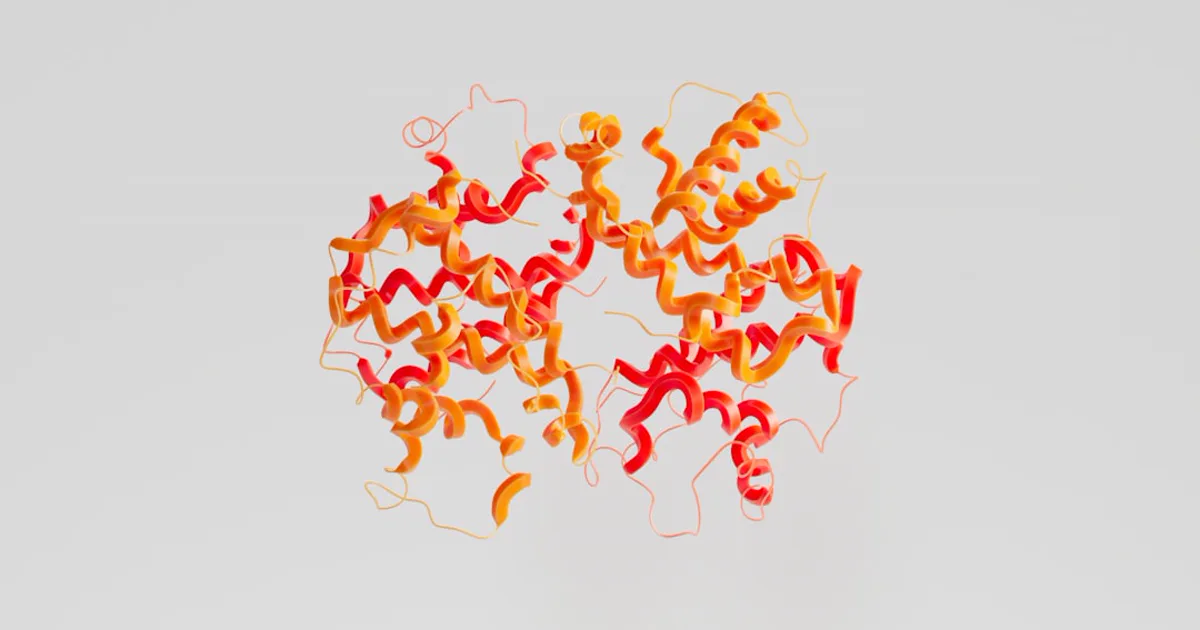
Hexarelin Chemistry: A GHRP-6 Analog and Its CD36 Binding Site
Hexarelin is a six-residue GHRP-6 analog with a story bigger than its size. Beyond the ghrelin receptor, it binds the scavenger receptor CD36 at a site researchers mapped down to a single contact residue. Here is the chemistry — sequence, receptors, binding site, and the shape and aromatic features that drive it.
by Research Assistant·
Hexarelin is a small molecule with an outsized chemical story. It's a synthetic hexapeptide — just six amino acids — offered strictly for research use only, not for human or animal consumption. Yet those six residues fit two entirely unrelated receptor "docking stations," and the one chemistry researchers find most interesting isn't the obvious one.
Most people first meet hexarelin as a growth hormone secretagogue — a peptide that engages the ghrelin receptor. But it also latches onto a scavenger receptor called CD36, at a binding site researchers have physically mapped down to a single contact residue. If you're researching this compound, that CD36 connection is the thread that ties its structure to more than two decades of scavenger-receptor science. This article walks through what hexarelin is, its two receptor addresses, how the CD36 site was pinned down, what actually drives the binding, and how chemists rebuilt the peptide into more selective tools.
What Hexarelin Is, Chemically
In one line: hexarelin is a lab-made six-residue peptide, a close analog of growth hormone-releasing peptide-6 (GHRP-6). Its amino acid sequence is His-D-2-methyl-Trp-Ala-Trp-D-Phe-Lys-NH2, and it carries the molecular formula C47H58N12O6 (about 887 g/mol), registered under CAS 140703-51-1. It also goes by the name examorelin.
One structural edit separates hexarelin from GHRP-6, and it's easy to describe: a methyl group added at the 2-position of the tryptophan at position two. Picture that tryptophan side chain as a flat, double-ring aromatic structure — an indole. Hexarelin decorates the ring with a single extra methyl group. Small as it is, that change is associated in the literature with greater potency and a longer-lasting effect, even as the shared receptor profile stays largely intact. For readers who want the sibling comparison, we cover how GHRP-6 and GHRP-2 differ chemically in a separate piece.
Two other features are worth naming. Hexarelin alternates natural L-amino acids with mirror-image D-amino acids — the D-2-methyl-Trp and the D-Phe. Its tail end is also capped as an amide, the Lys-NH2. Both tricks matter. The enzymes that chew up peptides are tuned for ordinary all-L chains with a free end, so swapping in D-residues and capping the terminus tends to make a peptide more stable against that breakdown. One caveat worth flagging: "examorelin" is also an investigational drug name, and research-grade material is not equivalent to any FDA-approved pharmaceutical product.
Here's the headline: the same six residues fit two receptors that have nothing to do with each other. One is the ghrelin/growth hormone secretagogue receptor, GHS-R1a, which hexarelin engages at nanomolar strength. The other is CD36, a scavenger receptor it binds far more loosely, in the low-micromolar range.
CD36 deserves a quick introduction, because it's central to everything that follows. It's a multifunctional scavenger glycoprotein — a large, sugar-decorated surface protein — found on heart muscle cells, the endothelial cells lining small blood vessels, and immune cells called macrophages. Normally it grabs onto things like fatty acids and modified lipoproteins. That a growth-hormone peptide would also stick to it was, at first, a surprise.
The evidence that CD36 genuinely mediates some of hexarelin's activity came from the heart. Researchers attached a light-activatable tag to hexarelin and used it to label proteins in cardiac tissue; the peptide tagged an approximately 84 kDa protein that sequencing identified as CD36. In perfused hearts, the functional response tracked with CD36 — and, critically, it was absent in hearts from CD36-null mice and from rats genetically lacking CD36. No CD36, no response. That places the effect on a pathway separate from the ghrelin receptor.
This dual-target behavior is a clean example of how one peptide can engage more than one receptor. It's also the reason hexarelin gets studied as a chemical probe of CD36, not just as a growth-hormone tool.
Mapping the CD36 Binding Site
Researchers didn't simply infer where hexarelin sits on CD36 — they physically pinned it down using photoaffinity cross-linking. The idea is elegant. Take hexarelin and attach a chemical handle — a residue called p-benzoyl-phenylalanine (Bpa) — that stays inert until you shine ultraviolet light on it. Let the tagged peptide settle into its binding pocket on CD36-rich cardiac membranes, then flash UV light, which makes the handle form a permanent covalent bond exactly where the peptide was touching the receptor. Now the peptide is welded in place, and you can cut the receptor apart to find out where.
Reading the fragments
The cutting happened in stages, each one narrowing the search. First, an enzyme called Endo F stripped off the sugar decorations, shrinking the receptor from about 88 kDa to roughly 55 kDa and confirming how heavily glycosylated it is. Next, the protease Glu-C chopped the protein and left a single labeled fragment of about 8 kDa — meaning the tag, and therefore the peptide, sat in one specific region. Finally, a reagent called CNBr, which cuts specifically after the amino acid methionine, released the peptide tag entirely. That last result was the key: it said the contact point sat right next to a methionine.
Put the fragment sizes together and the binding domain narrows to the CD36 segment spanning residues Asn132 to Glu177 — a 46-residue, non-glycosylated stretch — with Met169 identified as the direct contact residue. This is receptor biochemistry in its cleanest form: a specific ligand, a specific patch of protein, and a single residue where the two meet.
Sharing a Surface With Oxidized LDL
The hexarelin site doesn't sit in an empty neighborhood. It substantially overlaps the part of CD36 that binds oxidized LDL — the modified "bad cholesterol" particle — which occupies roughly residues Gln155 to Lys183 on the same receptor. Hexarelin and oxidized LDL are reaching for the same real estate.
The experiments back this up. Oxidized LDL competes with hexarelin for the receptor, blocking the peptide's photolabeling with a measured potency (an IC50 around 37 µg/ml), and the binding kinetics point to straightforward competition at an overlapping surface rather than a distant, indirect effect. That distinction matters, and it's worth understanding the difference between overlapping and allosteric binding sites — here "overlapping" is the precise word: the two ligands are literally jockeying for the same patch.
Why do researchers care? Because CD36 on macrophages is one of the receptors that pulls oxidized lipoproteins into cells — the early step in forming the "foam cells" studied in atherosclerosis research. Since the sites overlap, investigators have asked whether GHRP-family peptides might get in the way of that uptake. In cell-culture and apoE-deficient mouse models, researchers have studied exactly that question. We frame this as an open research direction, not an outcome: what the models show is competition at a shared surface, and the biology that might follow from it.
What Actually Drives CD36 Binding: Shape and Aromatics
Two features of the peptide do most of the CD36 binding work: the shape its backbone folds into, and its aromatic side chains. Neither is obvious from the flat sequence alone.
The bigger clue is conformation. GHRP-6 in solution behaves like a floppy random coil, with no fixed shape. The tighter-binding aza analog settles into a defined beta-turn instead — a specific hairpin fold, confirmed by CD and NMR spectroscopy. Affinity tracks with shape, a recurring theme in peptide chemistry that we unpack further in our explainer on why a peptide's shape governs its function. Shape isn't the only lever, though. The aromatic residues — especially the ring at position four — carry real weight, with aromatic-cation interactions contributing to how firmly the peptide grips the receptor. Swap that ring for a different one and the binding behavior shifts.
From a Promiscuous Peptide to a Selective Tool
Once researchers knew both the binding site and the drivers, they could do something useful: redesign the promiscuous GHRP-6 scaffold into molecules that hit CD36 while largely ignoring the ghrelin receptor.
The main trick is azapeptide chemistry. Replace one amino acid with a closely related surrogate called a semicarbazide — an "aza" residue — and you nudge the backbone toward that favorable beta-turn. These analogs are built by solid-phase submonomer synthesis and, in some cases, macrocyclization to lock in the shape. The selectivity payoff is striking: several analogs kept their micromolar grip on CD36 while shedding a hundred- to ten-thousand-fold of their ghrelin-receptor binding, and one azacyclopeptide — labeled 57c — reached an IC50 of 0.08 µM, roughly 23 times more potent at CD36 than the parent GHRP-6.
What have those selective tools shown? Strictly within cell-culture and animal models, CD36-targeted GHRP-6 azapeptides have displayed cardioprotective, anti-inflammatory, and retinal-protective activity in research settings. The anti-inflammatory effect appears to work by disrupting a CD36–TLR-2/6 receptor complex. And in a nice illustration of structure-driven tuning, changing the aromatic residue at position four flipped analogs between promoting and suppressing blood-vessel growth. These are observations from research models, not statements about outcomes in people.
Frequently Asked Questions
What is the amino acid sequence of hexarelin?
Hexarelin is a synthetic hexapeptide with the sequence His-D-2-methyl-Trp-Ala-Trp-D-Phe-Lys-NH2. It carries the molecular formula C47H58N12O6 (about 887 g/mol) and an amidated C-terminus. The defining feature versus its parent GHRP-6 is a methyl group added at the 2-position of the D-tryptophan indole ring.
How is hexarelin related to GHRP-6?
Hexarelin is a close structural analog of growth hormone-releasing peptide-6 (GHRP-6). Both are hexapeptides built on the same backbone, but hexarelin adds a single 2-methyl substitution to the position-2 tryptophan. That small change is associated with greater potency and a longer-lasting effect in the research literature, while leaving the shared receptor profile largely intact.
Where does hexarelin bind on the CD36 receptor?
Photoaffinity cross-linking studies localized hexarelin's binding site to the CD36 fragment spanning residues Asn132 to Glu177, with Met169 identified as the direct contact point. This region substantially overlaps the part of CD36 that binds oxidized LDL (roughly Gln155–Lys183), which is why researchers have studied whether the peptide competes with oxidized lipoproteins for the receptor.
Does hexarelin only act through the ghrelin receptor?
No. Hexarelin is a nanomolar agonist of the ghrelin/growth hormone secretagogue receptor (GHS-R1a), but it is also a low-micromolar ligand of the scavenger receptor CD36. Studies in cardiac tissue show that some of its cardiovascular actions persist through CD36 independent of the ghrelin-receptor pathway, which is a central reason researchers find the compound structurally interesting.
The Bottom Line
Hexarelin is a one-edit variation on GHRP-6 — a single methyl group on a tryptophan ring — whose real chemical interest lies elsewhere: in a well-mapped CD36 binding site running from Asn132 to Glu177, with the point of contact at Met169. That site overlaps the surface CD36 uses to grab oxidized LDL, which is what turned a growth-hormone peptide into a probe for scavenger-receptor research. The through-line is clean: structure leads to two receptors, two receptors lead to a physically mapped site, the site leads to the shape and aromatic drivers of binding, and those finally lead to selective azapeptide tools. To go deeper on the surrounding chemistry, our pieces on GHRP-6 versus GHRP-2 and multi-receptor peptide design pick up the thread. As always, everything here concerns material intended for research use only.
For research use only. Not for human or animal
consumption of any kind. The information in this article is for
educational purposes only and is not intended to diagnose, treat,
cure, or prevent any disease. The statements made have not been
evaluated by the U.S. Food and Drug Administration. These products
are NOT FDA APPROVED. Please consult with a licensed healthcare
professional before making any decisions regarding your health
or research.
Optides LLC is a chemical supplier. Optides LLC is not a
compounding pharmacy or chemical compounding facility as defined
under 503A of the Federal Food, Drug, and Cosmetic Act. Optides LLC
is not an outsourcing facility as defined under 503B of the Federal
Food, Drug, and Cosmetic Act.