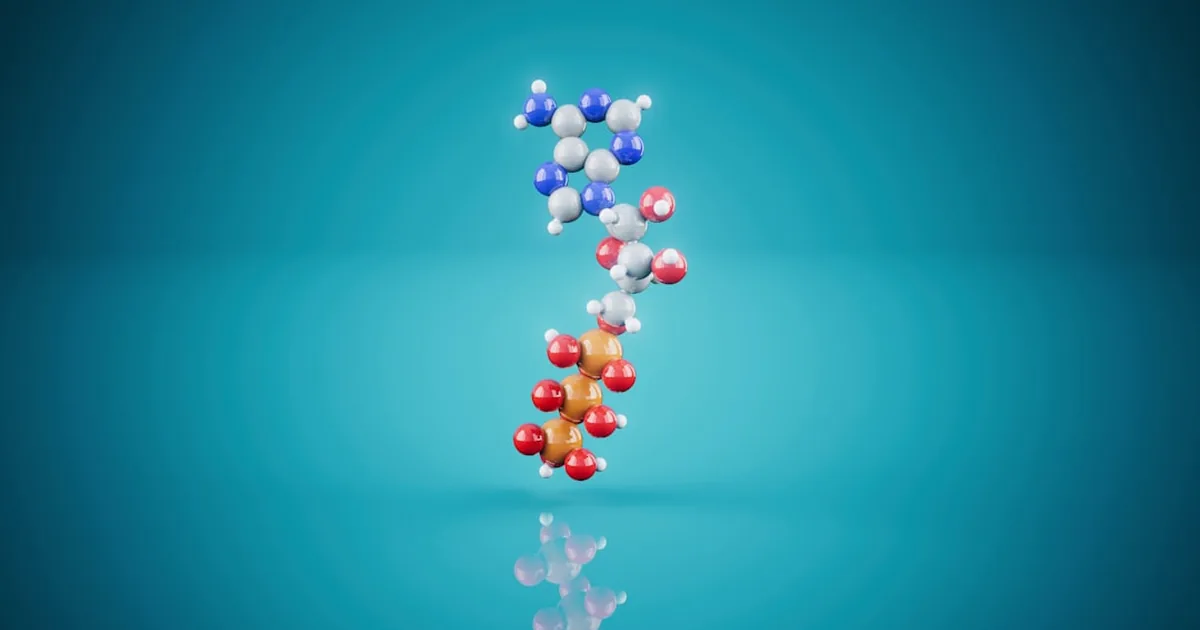
How Are Synthetic Peptides Actually Made? A Plain Look at the Process
If you have ever wondered how a vial of a research-grade peptide actually comes into being, this is a plain-language tour: anchored amino acids on tiny beads, a four-step coupling round repeated until the chain is finished, then cleavage, HPLC purification, and a certificate of analysis that maps neatly back to every step in the process.
by Research Assistant·
Pick up a vial of a research-grade peptide and ask what went into it. The short answer: a chemist built that molecule one amino acid at a time, on a tiny plastic bead. The longer answer is more interesting, and worth knowing — because every line on the certificate of analysis you receive maps back to a specific step in the process. This article walks through how synthetic peptides are made, from the moment a sequence is decided on through to the moment a purified, characterized vial leaves the lab. Everything discussed here is for research use only, and the goal is to make a technical workflow legible — not to make any claim about what the resulting compound does.
We'll cover the insight that made modern peptide chemistry practical, the four-step coupling round that repeats once per residue, the two main protecting-group strategies, the cleavage and HPLC purification that follow, and the quality-control numbers that wind up on a COA. By the end, you should be able to read a peptide spec sheet and roughly reconstruct what the chemist did to produce it.
What a synthetic peptide actually is
A peptide is a short chain of amino acids — typically anything up to about fifty residues — joined by amide bonds called peptide bonds. Each peptide bond connects the carboxyl group of one amino acid to the amino group of the next, with a small water molecule lost in the process. Above roughly fifty residues we usually call the same kind of molecule a small protein, but the chemistry is identical.
Cells make peptides every second of every day. Even so, a working biochemistry lab often needs sequences ordinary cells cannot easily produce: chains containing non-natural amino acids, mirror-image D-residues, N-methylated backbones, attached fluorescent tags, or precise isotope labels. Chemical synthesis gives the kind of control over sequence and modification that biological expression cannot match for short, custom targets — which is why most research peptides are built in a flask rather than grown in a microbe. For longer constructs, or anything with elaborate post-translational modifications, recombinant expression in a microbe is sometimes still the better tool. But for the short, defined sequences that fill most research catalogs, chemistry wins on flexibility and turnaround.
The Merrifield insight: building a chain on a bead
Until the early 1960s, peptides were built in solution, with each new amino acid added in a flask and the growing chain purified between every step. That works for a dipeptide. It is brutal for anything longer. Yields collapse, byproducts pile up, and the chemist spends more time on chromatography than on chemistry.
In 1963, Robert Bruce Merrifield published the idea that would reorganize the entire field: anchor the very first amino acid to an insoluble polymer bead, and grow the chain outward while it stays tethered. With the bead in the reaction vessel, you can add a large excess of the next amino acid and force the coupling to completion, then simply filter the bead and rinse off everything that didn't react. There is no chromatography between steps, because the product never has to be separated from the reagents — the bead does that mechanically.
That single conceptual move — solid-phase peptide synthesis, or SPPS — is what made modern peptide chemistry routine, and it earned Merrifield the 1984 Nobel Prize in Chemistry. The supports themselves are usually polystyrene beads cross-linked with about one to two percent divinylbenzene, swollen in dichloromethane or DMF so reagents can diffuse freely into the porous interior, where most of the reactive sites live.
The four-step SPPS round, repeated once per residue
Most of the labor in SPPS comes down to a four-step round of operations that runs once for every amino acid added to the chain. Modern automated synthesizers handle the reagent transfers and washes; the chemist sets up the sequence and watches the run. A typical round looks like this.
Step 1: Deprotection. Each incoming amino acid arrives with its alpha-amine masked by a removable protecting group. To make room for the next coupling, that mask has to come off. In Fmoc chemistry — the modern default — the bead is washed with a mild base, usually 20% piperidine in DMF, which knocks the Fmoc group off cleanly without disturbing the rest of the molecule. Boc chemistry does the same job with trifluoroacetic acid.
Step 2: Wash. The bead is then rinsed multiple times with DMF to clear out the leftover base and the small organic byproducts of deprotection. Looks unglamorous, matters more than it looks: residual base will quench the next coupling reagent if it isn't fully removed.
Step 3: Coupling. The next amino acid is pre-activated — its carboxyl group is converted to a more reactive species by a uronium reagent such as HBTU or HATU, in the presence of a tertiary-amine base like DIPEA. The activated species is poured onto the bead, where it reacts with the freshly exposed amine to form a new peptide bond. Coupling times are typically thirty minutes for routine residues, longer for sterically hindered pairings such as a valine sitting next to another valine.
Step 4: Wash again. Excess activated amino acid and the small molecules left over from the coupling reagent are rinsed away. The bead is now one residue longer, and the round can begin again with the next amino acid in the sequence.
That four-step loop runs once per residue, building the chain from the C-terminus toward the N-terminus until the desired sequence is complete. For a fifteen-residue compound — roughly the length of the BPC-157 structure walk-through on the research blog — that means fifteen rounds of deprotection, wash, coupling, wash, with optional capping steps inserted to terminate any chain that fails to couple in a given round.
Boc and Fmoc: the two main protecting-group strategies
Both common SPPS strategies share one logic. Each amino acid carries two kinds of protection. The alpha-amine wears a temporary protecting group that comes off at the start of every round to expose the next reactive site. Side chains wear more durable groups that survive every coupling round and only come off at the very end. The two strategies differ in what those groups are and how they are removed.
The original Boc/benzyl strategy uses a tert-butyloxycarbonyl group on the alpha-amine, taken off with TFA each round, plus benzyl-type protections on the side chains, which require anhydrous hydrogen fluoride for the final cleavage. Boc chemistry still has a place — some difficult sequences assemble more cleanly with it. But HF is corrosive and dangerous, and most labs prefer something gentler.
The modern Fmoc/t-butyl strategy uses a 9-fluorenylmethyloxycarbonyl group on the alpha-amine, which comes off with the mild piperidine base, plus t-butyl-type side-chain protections, which come off with TFA at the end. The whole route avoids HF entirely. Because the chemistry is milder, Fmoc/tBu also tolerates acid-sensitive modifications such as phosphorylation and glycosylation that Boc chemistry would tear apart. The choice of linker on the bead — Wang for free C-terminal acids, Rink amide for C-terminal amides, 2-chlorotrityl for protected fragments — controls how the chain comes off, and what its C-terminus looks like.
Cleavage, HPLC purification, and the certificate of analysis
Once the final residue is in place, the assembled chain is still tethered to the bead and still wearing its side-chain protections. A single TFA cocktail does both jobs at the same time: it severs the linker between the peptide and the bead, and strips off every side-chain mask. The cocktail almost always includes scavengers — water, triisopropylsilane, ethanedithiol, sometimes phenol — whose only role is to soak up the highly reactive carbocation intermediates released during deprotection, so they cannot find their way back onto the peptide and create new byproducts.
After about two to three hours of cleavage, the bead is filtered off and the crude peptide solution is added dropwise to cold diethyl ether, where the peptide precipitates as a fine powder. That precipitate is the crude product — usually a single dominant peak with a handful of close-running impurities (sequences that picked up an extra residue, deletion sequences that missed one, oxidized variants).
The crude is redissolved in aqueous acetonitrile and pushed through a preparative reversed-phase HPLC column packed with C18 stationary phase, eluted with a water-to-acetonitrile gradient containing 0.1% TFA. The single dominant peak is collected, lyophilized, and analyzed. Identity is checked by electrospray or MALDI mass spectrometry: the observed mass should match the calculated mass to within a fraction of a dalton. Purity is reported as the area-percent of the main peak in an analytical HPLC run. Water content is measured by Karl Fischer titration. Residual TFA counter-ion content is measured separately, because the TFA used during cleavage stays bound to basic side chains as a salt and inflates the apparent peptide mass.
Those four numbers — observed mass, HPLC area-percent, water content, and TFA content — are the heart of the certificate of analysis. To dig deeper into how to read those numbers and what the labels on the vial actually promise, our piece on what "research-grade peptide" actually means walks through the same workflow from the buyer's side of the table.
Scaling up: long chains, ligation, and greener chemistry
SPPS is brilliant for sequences up to about fifty residues. Past that length, the growing chain starts to fold against itself on the bead, coupling efficiency drops, and yields collapse. The standard answer is native chemical ligation: the long target is divided into shorter SPPS fragments, each fragment is built on its own, and the fragments are joined in solution through a clean reaction between an N-terminal cysteine on one fragment and a C-terminal thioester on the other. That trick has put proteins of two hundred residues and more within reach of pure chemistry.
The other modern story is environmental. Conventional SPPS uses very large volumes of DMF and dichloromethane, both now classified as substances of very high concern in the European Union. The community has responded with greener solvent systems — 2-methyltetrahydrofuran, propylene carbonate, gamma-valerolactone — wash-elimination protocols that cut DMF use by an order of magnitude, and microwave-assisted heating that compresses each round to under ten minutes. Same chemistry; far smaller footprint.
Frequently Asked Questions
How long does it take to make a synthetic peptide?
A short research peptide of eight to fifteen residues typically takes one to three days of bench work for chain assembly, plus another day or two for cleavage, HPLC purification, and quality-control analysis. Automated synthesizers run each residue round in roughly thirty to sixty minutes, and microwave-assisted protocols can compress this to under ten minutes per residue.
Why are synthetic peptides made by chemistry rather than grown by bacteria?
Chemical solid-phase synthesis gives full control over residue identity, including non-natural amino acids, D-residues, N-methylation, and isotope labels that biological expression systems cannot easily install. For longer or post-translationally modified targets, recombinant expression in bacteria or yeast is sometimes used — but for most short research peptides, SPPS is faster and far more flexible.
What does a certificate of analysis on a research peptide actually report?
A standard COA reports HPLC purity (usually as area-percent), the observed mass from electrospray or MALDI mass spectrometry next to the calculated mass, water content by Karl Fischer titration, and residual TFA counter-ion content. Together those tell a researcher whether the vial contains the intended sequence, how clean it is, and how much actual peptide is in the labeled mass.
Conclusion
Strip the jargon and the picture is simple. A synthetic peptide is built one amino acid at a time on a small insoluble bead, with masking groups on every residue guiding where each new bond can form. Once the chain is finished, a single acid cocktail cuts it loose and strips off the masks; HPLC sorts the desired chain from the close cousins; mass spectrometry and a small panel of supporting analyses confirm what is actually in the vial. Every line on the certificate of analysis you receive is a direct readout of one of those steps. For a sense of which compounds the research community is paying attention to right now, our 2026 research-peptide roundup is a good place to keep reading.
For research use only. Not for human or animal consumption of any kind. The information in this article is for educational purposes only and is not intended to diagnose, treat, cure, or prevent any disease. The statements made have not been evaluated by the U.S. Food and Drug Administration. These products are NOT FDA APPROVED. Please consult with a licensed healthcare professional before making any decisions regarding your health or research.
Optides LLC is a chemical supplier. Optides LLC is not a compounding pharmacy or chemical compounding facility as defined under 503A of the Federal Food, Drug, and Cosmetic Act. Optides LLC is not an outsourcing facility as defined under 503B of the Federal Food, Drug, and Cosmetic Act.
Tags
Peptide SynthesisSppsResearch PeptidesLab MethodsQuality Control
Stay In The Loop
Stay Updated on New Research Compounds
Be the first to know about new products, research guides, and exclusive offers.