Thymosin Beta-4: The Actin-Binding Peptide Researchers Are Studying
Thymosin beta-4 is one of the most abundant peptides inside our cells, yet it rarely gets named. This plain-language look explains what the 43-residue molecule is, how it buffers the cell's pool of actin building blocks, what the famous LKKTET motif does, and why its lack of a fixed shape makes it a model system for researchers.
by Research Assistant·
Inside a typical cell, thymosin beta-4 can reach about half a millimole per liter. That makes it one of the most plentiful small peptides you carry around without ever hearing its name. It is studied here strictly as a research compound, and is offered for research use only. What earns it a place in cell-biology textbooks isn't some dramatic effect on the body. It is a quiet, mechanical job: thymosin beta-4 is the main actin-sequestering peptide in many cell types. This article takes a plain look at what the molecule is, how it buffers the cell's supply of actin building blocks, what the well-known LKKTET motif actually does, why its floppy structure matters, and how it relates to the shorter TB-500 fragment researchers also work with.
What Thymosin Beta-4 Actually Is
Here's the short answer before the chemistry. Thymosin beta-4 is a single chain of 43 amino acids, weighing about 4.9 kilodaltons, encoded by the gene TMSB4X. The World Health Organization assigned it the international nonproprietary name "timbetasin." Its full sequence reads SDKPDMAEIEKFDKSKLKKTETQEKNPLPSKETIEQEKQAGES, and it was the second biologically active peptide isolated from a thymus preparation called Thymosin Fraction 5 to be completely sequenced and synthesized, according to the reference literature on the peptide.
The name is a small historical accident. When it first turned up in thymus tissue, researchers assumed it was a thymic hormone. That picture changed once it became clear the peptide sits at high levels across a wide range of cell types, and that its real day job involves binding actin. So the "thymosin" label stuck, even though the molecule isn't really a hormone of the thymus. For a sense of how different two peptides sharing the "thymosin" name can be, it's worth comparing it with thymosin alpha-1, a structurally unrelated thymic peptide that does very different work.
How a Small Peptide Buffers the Actin Pool
To see why thymosin beta-4 matters, you need one fact about actin. Actin is the protein cells use to build their internal scaffolding, and it comes in two forms: free single units called G-actin (the "G" is for globular) and long assembled filaments called F-actin (the "F" is for filamentous). Cells constantly switch actin between these two states to change shape and move. So they need a way to keep a reserve of free monomers ready without letting them assemble at the wrong time.
The one-to-one complex with G-actin
Thymosin beta-4 solves that problem by grabbing a single G-actin monomer and holding onto it, forming a tidy one-to-one complex. The peptide was actually discovered twice, under different names. A factor researchers had been calling "Fx" turned out to be indistinguishable from thymosin beta-4. That finding reframed the molecule, from a presumed thymic hormone into the cell's principal actin-buffering peptide.
Holding monomers without blocking assembly
The clearest way to picture the mechanism is as a chemical buffer. The relationship runs both directions: F-actin can release a monomer, that free G-actin can be captured by thymosin beta-4, and when the cell needs to build filaments the peptide lets the monomer go again. Researchers write it as a reversible chain — F-actin in equilibrium with G-actin plus thymosin beta-4, which is in turn in equilibrium with the G-actin/thymosin complex. The binding is firm but not permanent, with a dissociation constant around 0.7 to 1 micromolar, a value measured for both thymosin beta-4 and its close relative thymosin beta-10 in studies of actin-monomer sequestering proteins. Think of it as a holding bay for construction blocks: plenty are kept on hand, but they're released the moment a wall needs building.
The LKKTET Motif and the Extended Binding Interface
Read about thymosin beta-4 anywhere and you'll run into six letters: LKKTET. This is a short stretch of sequence that begins at residue 17 and is strongly conserved across the whole beta-thymosin family, which is why it's so often called "the actin-binding motif." Useful shorthand, but a little misleading.
Careful mutational work — changing one residue at a time and watching what happens to actin binding — has mapped the actin-binding site in detail. Both the N-terminal part of the peptide, roughly residues 1 through 16, and the central LKKTET region contribute charged and water-avoiding contacts to the actin surface. The binding doesn't happen at one neat pocket. Structural modelling based on crystallography shows that essentially the entire length of the peptide stretches across the actin monomer when the two join, so the LKKTET label names an important contact point rather than the whole story.
An Intrinsically Unstructured Peptide and the WH2 Family
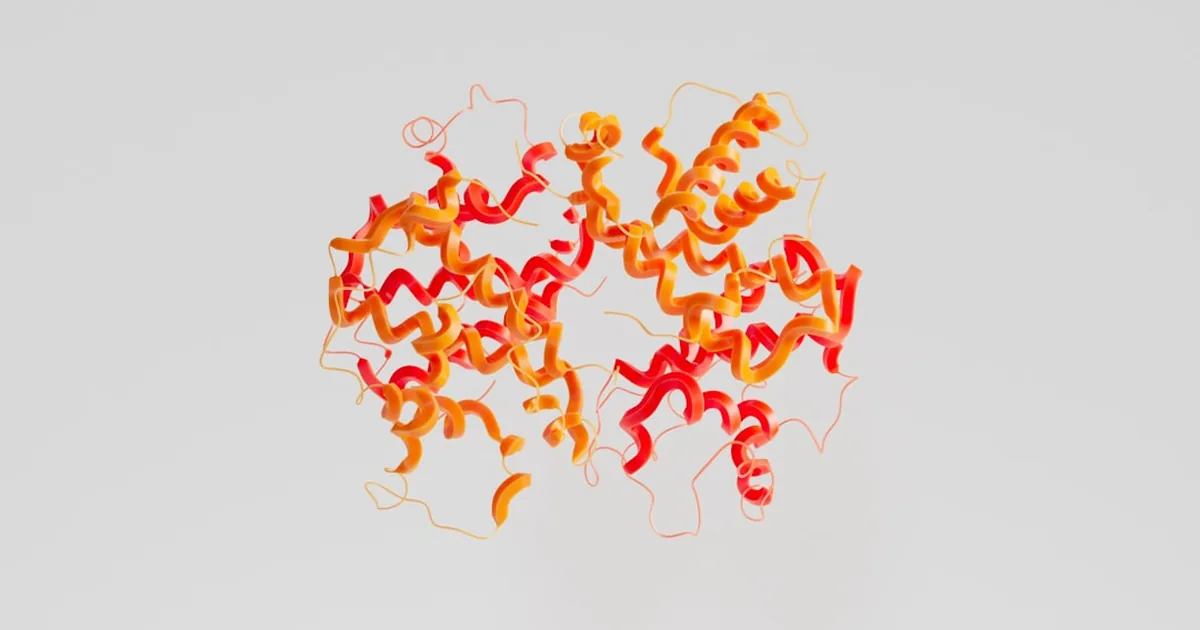
One of the more interesting things about thymosin beta-4 is what it looks like on its own: almost nothing. In water, the free peptide has no stable fold. Molecules like this are called intrinsically unstructured peptides, and they only snap into a defined shape when they meet a binding partner. If the idea that disorder can shape function is new to you, our explainer on intrinsically unstructured peptides covers the general principle.
That flexibility connects thymosin beta-4 to a broader cast of actin regulators. Structural studies of how the peptide sequesters a monomer place it alongside the WH2 (WASP-homology 2) domain family, a group of small actin-binding modules that share the trick of folding only on contact with actin. For researchers, the lack of a fixed structure is a feature, not a flaw. A peptide with no committed shape of its own can adapt to several different partners, a versatility scientists describe as "moonlighting." Thymosin beta-4 has become a reference example for how a disordered peptide can do more than one job.
Why Researchers Study Thymosin Beta-4
It helps to be precise about what "studied" means here. The interest in thymosin beta-4 comes from what happens in cell-culture and animal models, not from claims about people. With that framing in place, two observations explain much of the laboratory attention.
First, the same region of the peptide that binds actin has been linked, in experimental models, to cell migration and to the formation of new blood vessels — a process called angiogenesis. Researchers showed that the actin-binding site is tied to this angiogenic activity, which suggests the structural element doing the monomer-buffering also takes part in how cells move and organize. Second, the peptide isn't confined to the cytoplasm. It has also been found in the cell nucleus, hinting at roles beyond the straightforward actin-buffering described above and reinforcing that "moonlighting" picture. Across all of this work, the observations belong to cell and animal models, and the compound remains a research material rather than anything intended for living subjects.
How Thymosin Beta-4 Compares to the TB-500 Fragment
People researching thymosin beta-4 almost always come across TB-500, and the two are easy to confuse. They're not the same molecule. TB-500 is a synthetic peptide built to correspond to an active region of thymosin beta-4, rather than the full 43-residue chain. The two share the actin-binding stretch that gives the parent peptide its function, but they differ in overall length and exact sequence. For the structural particulars, our companion piece on the TB-500, the synthetic fragment of this peptide lays them out.
One caution worth repeating: when a compound's name overlaps with a recognized drug or trademarked product, research-grade material is not equivalent to any approved pharmaceutical product of the same name. The research peptide on a lab bench and a regulated medicine are different things, even when they share a label.
Frequently Asked Questions
What does thymosin beta-4 do at the molecular level?
In cell studies it binds a single monomer of globular (G) actin and holds it, acting as a buffer that keeps a reserve of actin subunits available. By sequestering monomers it opposes their spontaneous assembly into filaments until the cell signals for filament growth.
What is the LKKTET motif?
LKKTET is a six-residue sequence beginning at position 17 that is conserved across the beta-thymosin family and is often called the actin-binding motif. Structural work shows it is one important contact point, but essentially the entire extended peptide touches the actin monomer.
Is thymosin beta-4 the same as TB-500?
No. TB-500 is a synthetic peptide corresponding to an active region of thymosin beta-4, not the full 43-residue molecule. They share the actin-binding region but differ in length and exact sequence, and research-grade material of either is not an approved pharmaceutical product.
Why is thymosin beta-4 considered "intrinsically unstructured"?
In water the peptide has no stable fold. It only adopts a defined shape when it binds a partner such as actin. This flexibility is what lets one small peptide interact with several different partners, a behavior scientists call moonlighting.
Conclusion
Strip away the historical name and thymosin beta-4 is best understood as the cell's principal actin-sequestering peptide: a small, flexible, 43-residue molecule that buffers the pool of free actin monomers through an extended interface that includes, but isn't limited to, the conserved LKKTET motif. Its lack of a fixed structure links it to the wider WH2 family and explains why one short chain can interact with several partners. For anyone mapping how cells regulate their internal scaffolding, it stays a clean reference point — and a natural next stop is the related research on actin-binding fragments and other disordered peptides on this site.
For research use only. Not for human or animal consumption of any kind. The information in this article is for educational purposes only and is not intended to diagnose, treat, cure, or prevent any disease. The statements made have not been evaluated by the U.S. Food and Drug Administration. These products are NOT FDA APPROVED. Please consult with a licensed healthcare professional before making any decisions regarding your health or research.
Optides LLC is a chemical supplier. Optides LLC is not a compounding pharmacy or chemical compounding facility as defined under 503A of the Federal Food, Drug, and Cosmetic Act. Optides LLC is not an outsourcing facility as defined under 503B of the Federal Food, Drug, and Cosmetic Act.